

[HGPI Policy Column] (No. 77) — From the Blood Disorders Project “Bringing Cancer Care Closer to Home: Lessons for Japan’s Blood Cancer Care”
date : 10/9/2026
Tags: Blood Disorders, Cancer, HGPI Policy Column, NCDs

![[HGPI Policy Column] (No. 77) — From the Blood Disorders Project “Bringing Cancer Care Closer to Home: Lessons for Japan’s Blood Cancer Care”](https://hgpi.org/en/wp-content/uploads/sites/2/HGPI_20261006_Policy-Column-Blood-Disorders.png)
<POINTS>
- As more blood cancers require long-term management, patients face a growing burden of time spent commuting to treatment and the cost of ongoing care. Building a system that allows patients to continue treatment close to home, without compromising care quality, has become a new challenge.
- The United States, England, and Ireland have adopted different models for bringing cancer care closer to where patients live, combining centralized specialist treatment with continuing care delivered through more accessible local providers, offering useful lessons for Japan.
- Although Japan has achieved excellent outcomes through its network of specialized hospitals, hematology remains overwhelmingly hospital-based, with a hospital-to-community physician ratio of approximately 40:1, highlighting the need to strengthen community hematology and regional collaboration.
- Building a more sustainable model of blood cancer care in Japan will require clearer role-sharing between specialist and community providers, stronger incentives for community-based care, and measurable national frameworks to support and evaluate the transition toward shared care.
Introduction
Many blood cancers, once acute conditions requiring intensive treatment, are now managed as long-term chronic conditions thanks to advances in cancer therapeutics. This shift has changed what good care requires, not just effective treatment but treatment that patients can sustain often for the rest of their lives. As treatment, hospital visits, and medication now extend over many years, patients face what is increasingly recognized as time toxicity, the cumulative burden of time spent in treatment and travel, and financial toxicity, the ongoing financial strain of long-term care costs. For many people living with blood cancers, managing these burdens has become just as important as managing the disease itself.
These burdens depend heavily on where care is delivered. Japan’s cancer care system, built around designated cancer treatment hospitals and other specialized institutions, has produced excellent treatment outcomes. However, the same concentration that enables excellent acute care creates considerable difficulty for patients who require frequent, long-term outpatient visits. For many patients, the nearest institution able to manage their treatment may be a considerable distance from their home. Establishing a system that enables patients to continue treatment near where they live, without compromising the quality of advanced care, has therefore become an urgent priority.
This column examines how three health systems have sought to address this challenge, and considers what lessons, including from Japan’s own emerging initiatives, may be drawn for policy in this field.
The Japanese Gap
Japan’s cancer care delivery system, organized around a network of designated cancer treatment hospitals, has provided substantial improvements in the quality and equity of care. However, within the field of blood cancer, this same structure presents particular difficulties.
(1) Physician Maldistribution
One of these difficulties is the stark imbalance between hospital-based and community-based hematology care. According to the Ministry of Health, Labour and Welfare’s 2024 overview of statistics on physicians, dentists, and pharmacists, while the ratio of hospital-based to community-based physicians stands at roughly 5:1 in cardiology and 3:1 in gastroenterology, in hematology it is approximately 40:1, reflecting a significant concentration of care in hospitals. This concentration also varies sharply by region: the national average is approximately 2.3 hospital-based hematology specialists per 100,000 population, but this ranges from roughly 5.2 in Kyoto to roughly 1.1 in Aomori, which is a nearly fivefold gap. This scarcity is reinforced by a structural disincentive: a university hospital can lose medical reimbursement when it dispatches a physician to a community institution, even as physicians face tightening constraints on working hours under national work-style reform. As a result, community hematology remains comparatively rare, and hospital hematologists end up bearing responsibility for the care of many patients, including those in stable follow-up phases who could safely be managed in community settings.
(2) Uncoordinated Referral Pathways
This concentration exists alongside a related structural challenge. Japan’s regional collaboration critical pathways, a mechanism in which a specialist hospital and a local clinic share a standardized document setting out a patient’s follow-up plan after initial treatment, are now applied to the five major solid cancers and established in all forty-seven prefectures. However, this system remains considerably less developed for blood cancer. Solid tumors, which are cancers other than blood cancers that form masses in organs or tissues, often progress along a relatively linear path. By contrast, blood cancers more often involve prolonged chemotherapy, repeated cycles of remission and relapse, and extended follow-up after transplantation, a pattern that fits awkwardly within pathways designed around a more linear course. A small number of institutions, including Kanagawa Cancer Center and Osaka International Cancer Institute, have developed pioneering models of collaboration. However, no standardized approach has yet been adopted nationally. Even where regional capacity exists, the absence of standardized referral criteria and shared clinical information systems continues to impede coordination between institutions.
The consequences of this are visible in patients’ everyday experience. For example, Health and Global Policy Institute’s (HGPI) policy recommendations in the field of blood disorders note that elderly patients with myelodysplastic syndrome (MDS) who require regular blood transfusions have been reported to drive themselves weekly to distant hospitals for treatment, and some patients with chronic myeloid leukemia (CML), given how long their treatment continues, already travel across prefectures by bullet train to reach a specialist center.
(3) Rising Demand
These structural gaps are likely to become increasingly consequential given projected demographic trends. The number of new blood cancer cases in Japan is projected to rise substantially by 2040 as the population ages, with prevalence increasing faster than for cancer overall through 2050, even as the working-age population continues to decline. A system that requires elderly patients to travel considerable distances for routine outpatient care, while relying on specialized hospitals to absorb the entirety of this growing demand, is unlikely to remain sustainable under these conditions.
Global Context: Three Models for Bringing Cancer Care Closer to Home
These challenges are not unique to Japan. Health systems in other countries have had to find ways to address similar issues. The following section looks at how these challenges have been approached in the United States, England, and Ireland.
- United States: Community Oncology
In the United States, the Community Oncology Alliance has advocated for a model of cancer care delivered close to where patients live, rather than concentrated in distant academic centers. According to the Alliance, the majority of Americans with cancer are currently treated within community oncology practices, supported by more than 5,000 community oncologists across approximately 950 practices nationwide. The Alliance describes the model as distinguished by four factors: a personal relationship between patients and their care team, and convenience from being located within the communities where patients live and work. It also points to clinical excellence, noting that most new cancer drugs approved in the United States in recent years were studied in later-phase clinical trials conducted at community oncology practices, and affordability, since treatment in community settings generally costs less than the same treatment delivered in a hospital. However, highly complex procedures, such as stem cell transplantation, and early-phase clinical trials remain concentrated at academic medical centers, with community oncologists typically coordinating referrals for these specific elements of care before resuming responsibility for ongoing treatment.
- England: Coordination between Cancer Alliances
England organizes its cancer services through 20 regional Cancer Alliances, which succeeded the earlier Cancer Networks and are responsible for coordinating the cancer care pathway within defined geographic areas. Each Alliance brings together specialist centers, hospital trusts, and primary care providers to plan and deliver treatment collaboratively. Under this model, complex diagnostics and multidisciplinary treatment remain concentrated at specialist centers, while the National Cancer Plan for England, published in 2026, sets a national ambition for chemotherapy administration and routine follow-up to move increasingly into local hospitals and community settings closer to patients’ homes over the coming decade, with most outpatient cancer care expected to shift outside hospitals by 2035. Separately, accountability across the system is maintained through the Faster Diagnosis Standard, which requires that patients receive a cancer diagnosis or have it ruled out within a set number of days of referral. Each Alliance reports its own performance against this standard, with the required threshold rising over time.
- Ireland: The Hub-and-Spoke Model
Ireland has taken this same division between specialist and routine care further than England, embedding it even more explicitly in national policy. Under the National Cancer Control Programme (NCCP), established in 2007, the country’s cancer services were reorganized around eight designated cancer centers, together with an additional paediatric center, and a wider network of approximately 26 local hospitals authorized to administer systemic anti-cancer therapy. Hub centers were designated according to defined population catchments, and decisions about which services to consolidate were guided by clinical case-volume evidence, with transfers phased in only once receiving institutions had demonstrated sufficient capacity. Most of the initial diagnosis, surgery, and specialized blood cancer care are concentrated at these hub centers, while chemotherapy and continuing care are delivered at spoke sites located closer to patients’ homes. This structure is intended to preserve the quality benefits associated with centralization while reducing the travel burden associated with routine care.
Although the specific mechanisms differ across these three health systems, each reflects a common underlying principle. Highly specialized treatment should remain concentrated where such concentration yields the greatest clinical benefit, while routine and continuing care should be positioned as close to the patient as circumstances allow.
Implications for Japan
These three models point to a clear direction for Japan: combining highly specialized treatment at designated centers with ongoing care delivered closer to patients’ homes. Three elements are particularly important to achieving this.
- Clarifying the Division of Clinical Roles
Ireland’s hub-and-spoke model provides a clear example of how this division of roles, common to all three models mentioned, can be achieved: using defined population catchments and clinical case-volume evidence to determine which institutions should serve as specialist hubs for advanced diagnostics, induction therapy, transplantation, and treatments such as CAR-T cell therapy, and which community providers are equipped to take on maintenance therapy, follow-up, and supportive care. Making this possible would require the division of responsibilities to be reflected not only in clinical practice but also in policy, through designation criteria, performance standards, and reimbursement systems that recognize the distinct roles of specialist and community providers.
Japan has already begun to move in this direction. HEMA-Bridge, launched in April 2026, is developing shared-care frameworks, follow-up guides, disease-specific monitoring protocols, and relapse-alert checklists to support community physicians in providing ongoing care in the follow-up phase. It demonstrates that many of the practical foundations for shared care can be developed. However, it does not include formal hub-and-spoke designation criteria or new reimbursement for community physicians providing follow-up care, and remains a two-prefecture pilot. Closing this gap will take more than isolated efforts like these, or the ones at Kanagawa and Osaka. It is necessary to build the kind of standardized, population-based designation system that Ireland has put in place nationally.
- Investment in Regional Capacity
The scale of the United States’ community oncology workforce, more than 5,000 physicians spread across roughly 950 practices, is what makes local cancer care a realistic option for most patients. In Japan, community-based hematologists are rare and unevenly distributed across regions. Building this kind of workforce in Japan is complicated, partly because of the reimbursement disincentive. Therefore, addressing this disincentive is likely as necessary as expanding the workforce itself. Reforming reimbursement so that university hospitals are not penalized for dispatching physicians to community institutions, alongside strengthening the regional hematology workforce more broadly, could play an important role in making community-based blood cancer care available to patients across the country, as it is in the United States.
- Standardized Information-Sharing and Referral Criteria
England offers the clearest example of how policy can support coordinated cancer care across institutions. Rather than relying on general expectations of collaboration, England’s Faster Diagnosis Standard shows how a single measurable target paired with mandatory regional reporting can create sustained pressure for improvement across otherwise independent institutions.
A comparable approach could be applied to community-based blood cancer care in Japan, for example by setting targets for the proportion of stable patients transitioned to community follow-up within a defined period and publishing performance by prefecture. Such a system would require standardized referral criteria, shared treatment protocols, and interoperable clinical information systems to support continuity of care across institutions, none of which yet exist at a national level in Japan.
Conclusion
Japan’s treatment outcomes for blood cancers are already among the strongest in the world. The three models highlight areas where further development is needed: reimbursement mechanisms that better support community-based care, clearer designation criteria grounded in population needs and service capacity, and measurable indicators to monitor progress in transitioning appropriate patients to community follow-up. Recent initiatives, including HEMA-Bridge, demonstrate that Japan has already begun to move in this direction, but they remain an important first step rather than a comprehensive solution. Addressing these challenges will require continued collaboration among industry, government, academia, and civil society. HGPI will continue to contribute to this discussion through its Blood Disorders Project by advancing policy dialogue on the development of a more sustainable, patient-centered model of blood cancer care.
References
- Can. (n.d.). Implementing a National Cancer Information System in Ireland. https://www.all-can.org/efficiency-hub/implementing-a-national-cancer-information-system-in-ireland/
- Citizens Information. (n.d.). Cancer services. https://www.citizensinformation.ie/en/health/health-services/cancer-services/cancer-services/
- Community Oncology Alliance. (n.d.-a). What is community oncology? https://communityoncology.org/about/what-is-community-oncology/
- Community Oncology Alliance. (n.d.-b). Who we are. https://communityoncology.org/about/who-we-are/
- Department of Health. (2017). National Cancer Strategy 2017–2026. https://www.gov.ie/en/department-of-health/publications/national-cancer-strategy-2017-2026/
- Harrison, C. J., Spencer, R. G., & Shackley, D. C. (2019). Transforming cancer outcomes in England: Earlier and faster diagnoses, pathways to success, and empowering alliances. Journal of Healthcare Leadership, 11, 1–10. https://doi.org/10.2147/JHL.S181203
- Hayes, J., Hoverman, R. J., Brow, M. E., Dilbeck, D. C., Verrilli, D. K., Garey, J., Espirito, J. L., Cardona, J., & Beveridge, R. (2015). Cost differential by site of service for cancer patients receiving chemotherapy. American Journal of Managed Care, 21(3), e189–e196. https://www.ajmc.com/view/cost-differential-by-site-of-service-for-cancer-patients-receiving-chemotherapy
- Health and Global Policy Institute. (2026). Policy recommendations in the field of blood disorders: Building a healthcare ecosystem centered on patients and those affected. https://hgpi.org/en/research/ncd-bd-20260413.html
- Health Service Executive, National Cancer Control Programme. (2014). Report on the implementation of “A Strategy for Cancer Control in Ireland 2006.” https://www.drugsandalcohol.ie/23368/1/NCCPHSE%20strategy%20cancer%202006.pdf
- Medical DOC. (2026). Tackling the challenges arising from advances in blood disorder treatment: Launch of the HEMA-Bridge project. https://medicaldoc.jp/m/column-m/202602t0378/
- Ministry of Health, Labour and Welfare (2025). Summary of Equalization and Centralization of the Cancer Care Delivery System for 2040. https://www.mhlw.go.jp/stf/newpage_60675.html
- Ministry of Health, Labour and Welfare. (2025). Overview of Statistics on Physicians, Dentists, and Pharmacists, 2024. https://www.mhlw.go.jp/toukei/saikin/hw/ishi/24/index.html
- Ministry of Health, Labour and Welfare. (2025). Summary of the New Regional Healthcare Plan. https://www.mhlw.go.jp/stf/newpage_47465.html
- Narimatsu, H., Sakaguchi, M., Nakamura, S., & Katayama, K. (2020). Future patient incidence in hemato-oncology: A study using data from cancer registries in Japan. Risk Management and Healthcare Policy, 13, 2407–2414. https://doi.org/10.2147/RMHP.S277207
- Nguyen, C. A., Beaulieu, N. D., Wright, A. A., Cutler, D. M., Keating, N. L., & Landrum, M. B. (2023). Organization of Cancer Specialists in US Physician Practices and Health Systems. Journal of clinical oncology: official journal of the American Society of Clinical Oncology, 41(26), 4226–4235. https://doi.org/10.1200/JCO.23.00626
- Nguyen, P. T., Hori, M., Matsuda, T., & Katanoda, K. (2023). Cancer prevalence projections in Japan and decomposition analysis of changes in cancer burden, 2020–2050: A statistical modeling study. Cancer Epidemiology, Biomarkers & Prevention, 32(12), 1756–1770. https://doi.org/10.1158/1055-9965.EPI-23-0754
- NHS England. (n.d.). Cancer Alliances – improving care locally. https://www.england.nhs.uk/cancer/cancer-alliances-improving-care-locally/
- (2026). Novartis launches new collaborative model with the Japanese Society of Hematology, Fukushima Prefectural Medical Association, and Mie Prefectural Medical Association to address regional disparities in blood disorder care. https://www.novartis.com/jp-ja/news/media-releases/prkk20260413
- UK Government. (2026). The National Cancer Plan for England: Delivering world class cancer care. https://www.gov.uk/government/publications/national-cancer-plan-for-england/the-national-cancer-plan-for-england-delivering-world-class-cancer-care-accessible-version
Authors
Selina Geerlings (Program Specialist, Health and Global Policy Institute)
Daichi Watanabe (Manager, Health and Global Policy Institute)
Related Posts
-
2026-05-29
[Policy Recommendations] Policy Recommendations in the Field of Blood Disorders "Building a Healthcare Ecosystem Centered on Patients and Those Affected" (April 13, 2026)
-
2026-08-07
[HGPI Policy Column] (No.76) - From the Planetary Health Project “No. 19: Heat and Health - The Health Risks of Climate Change and Society's Preparedness”
-
2026-07-29
[HGPI Policy Column] (No. 75) What Is the WHO Civil Society Commission? — The Institutionalization of Civil Society Participation in WHO and Japan’s Engagement
-
2026-07-01
[HGPI Policy Column] (No.74) “The Meaning of Considering Decision-Making Methods in Policy: The Policy-Making Process in the AI Era”
-
2026-08-24
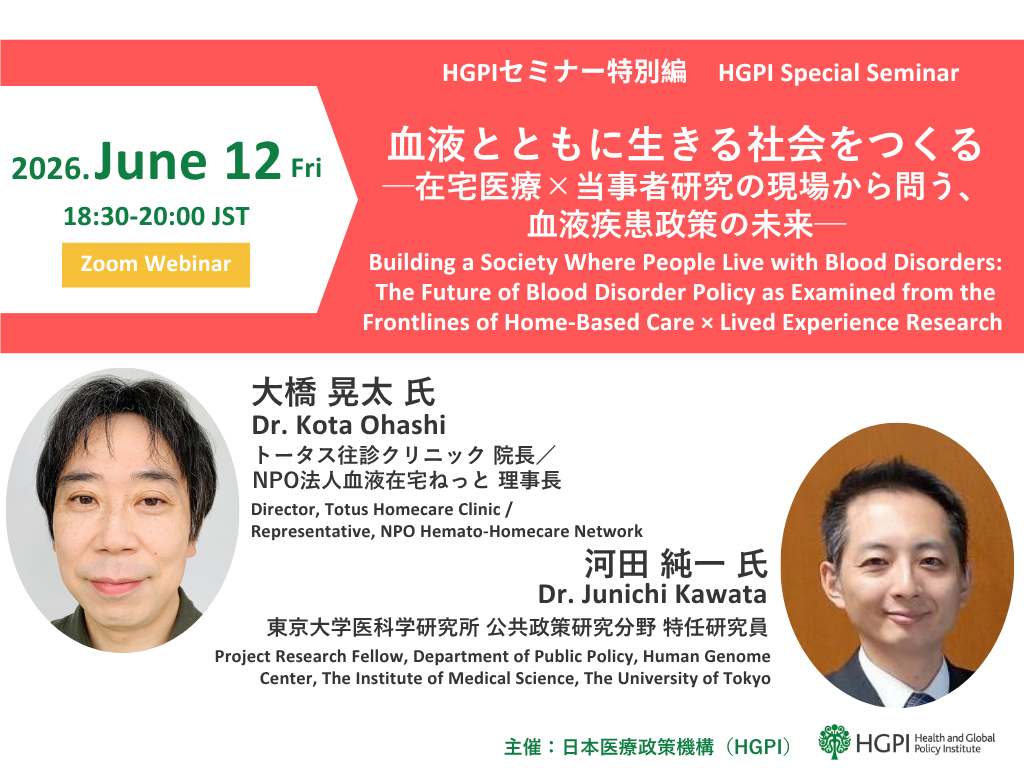
[Event Report] HGPI Special Seminar “Building a Society Where People Live with Blood Disorders: The Future of Blood Disorder Policy as Examined from the Frontlines of Home-Based Care × Lived Experience Research” (June 12, 2026)
-
2025-09-01
[Discussion Points] Blood Disorders Measures Promotion Project “Current Issues and Prospects for Advancing Blood Disorders Control Promotion” (July 23, 2025)
Top Research & Recommendations Posts
Featured Posts
-
2026-05-18
[Registration Closed] Kick-off Panel Discussion “From Africa and Japan, Drawing from Perspectives Around the World:A Platform for Cultivating a Philosophical Health Dialogue Together” (June 15, 2026)
![[Registration Closed] Kick-off Panel Discussion “From Africa and Japan, Drawing from Perspectives Around the World:A Platform for Cultivating a Philosophical Health Dialogue Together” (June 15, 2026)](https://hgpi.org/en/wp-content/uploads/sites/2/HGPI_20260615_Eyecathch_panel-discussion-From-Japan-and-Africa-in-Discussion-with-the-World_2.png)
-
2026-08-28
[Announcement] The 3rd Kiyoshi Kurokawa Award: Call for Nominations (Deadline: November 30, 2026)
![[Announcement] The 3rd Kiyoshi Kurokawa Award: Call for Nominations (Deadline: November 30, 2026)](https://hgpi.org/en/wp-content/uploads/sites/2/Kiyoshi-Kurokawa-Award_3rd_nominations_eyecatch_caseB_ENG_web_20260929_v0.5.jpg)
-
2026-09-01
[Registration Closed] HGPI Salon 2025-2026 Looking Ahead to the Future of Japan’s Social Security System “Session 6: Japan’s Health Policy through the Lens of Global Security” (October 13, 2026)
![[Registration Closed] HGPI Salon 2025-2026 Looking Ahead to the Future of Japan’s Social Security System “Session 6: Japan’s Health Policy through the Lens of Global Security” (October 13, 2026)](https://hgpi.org/en/wp-content/uploads/sites/2/HGPISalon2025-20266.png)
-
2026-09-17
[Registration Open] (Webinar) The 145th HGPI Seminar “Toward Better AMR Measures at Elderly Care Facilities—Considering Infectious Disease Control in a Super-Aged Society From a Policy Perspective” (October 27, 2026)
![[Registration Open] (Webinar) The 145th HGPI Seminar “Toward Better AMR Measures at Elderly Care Facilities—Considering Infectious Disease Control in a Super-Aged Society From a Policy Perspective” (October 27, 2026)](https://hgpi.org/en/wp-content/uploads/sites/2/HGPIseminar145.png)
-
2026-10-06
[Registration Open] (Webinar) The 146th HGPI Seminar “How We Can Build a Society That Supports Choices Around Organ Donation: Exploring Decision-Making by Citizens and a Multi-Layered Approach Through Strategic Social Marketing” (November 9, 2026)
![[Registration Open] (Webinar) The 146th HGPI Seminar “How We Can Build a Society That Supports Choices Around Organ Donation: Exploring Decision-Making by Citizens and a Multi-Layered Approach Through Strategic Social Marketing” (November 9, 2026)](https://hgpi.org/en/wp-content/uploads/sites/2/HGPI_20261001_Eyecatch_HGPIseminer-146th-1.png)
